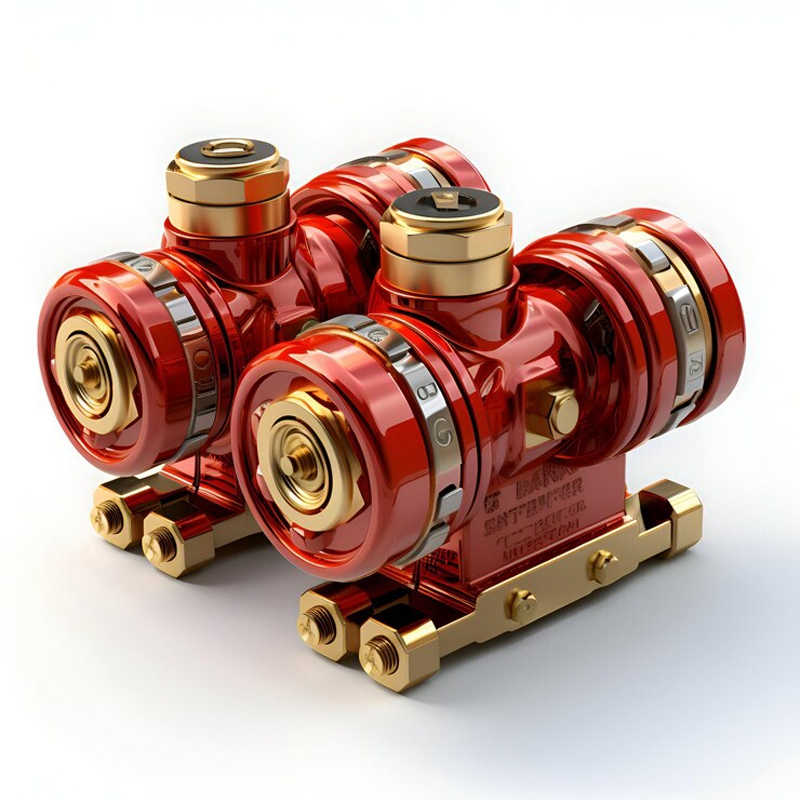
Parts outside a standard category fail in ways specific to the part. An injection screw is eroded at the flight by glass fibre filler. A needle valve stem is scoured by sand in the process fluid, and the flow it controls drifts as the stem wears. A tungsten electrode oxidises at the arc. Special custom part PVD coating starts by identifying which of these is the real problem, because one film is wrong for half of them.
Two practical limits run through this work. The first is thickness: a PVD film is measured in micrometres, so it can protect a surface, change its friction or its conductivity, but it cannot rebuild a part that has lost material. The second is fit: a stem in a guide bushing, a thread that has to engage and a seat that has to seal are dimension-critical, and the film has to be planned around the clearance that exists.
Typical parts we coat
- Processing parts: injection and extrusion screws, screw flights, barrel components, mixers
- Fluid control parts: needle valve stems, ball valves and seats, double block valves, plug valves
- Electrodes and electrical parts: tungsten electrodes, graphite electrodes, heater parts
- Hard and brittle parts: ceramic and alumina components, glass parts, optical mounts
- Moulded and light-weight parts: PE, PC and ABS housings, PI films, carbon-fibre parts
- Sport and outdoor parts: fishing reel spools, golf club heads and shafts, bicycle components
Coating options and why they fit
Titanium nitride (TiN)
TiN is the general wear and corrosion film for steel and copper parts, and the default for valve components. Typical hardness is 2000-2500 HV, the film runs 0.5-5 micrometres, and the process temperature is held at 200-450 degrees Celsius. On a ball valve it is reported to survive 1000 h of salt spray where the uncoated valve pitted at 200-300 h.
Chromium nitride (CrN) and the metal films
CrN is chosen when corrosion resistance is the primary demand, and the plain metal films when conductivity or reflectivity matters more. CrN sits at 1800-2200 HV, with a conductivity of 200-500 S/cm and 1000 h of salt spray without red rust. A chrome metal film is reported over 200-800 nm, with a scratch load above 50 N and 80-90 per cent reflectance.
DLC (diamond-like carbon) and Ta-C
The carbon films are the low-friction, low-sticking options and the natural answer to a material that builds up. The amorphous form of DLC (diamond-like carbon) and the tetrahedral form are reported at up to HV8000 with a friction coefficient of 0.1 or below, the tetrahedral form at 61 GPa, and a soft and hard multilayer bringing the residual stress down from -4.17 to -0.54 GPa.
Temperature-resistant systems for hot and electrical parts
Where the working temperature is high, the alloy nitrides take over: TiAlN is reported with its high-temperature capability raised to 800 degrees Celsius, against roughly 500 for TiN. For electrodes the graphite-doped variants are reported with a resistivity below 10^-6 ohm.m and about 40 per cent less electrode consumption, with oxidation resistance raised to 800 degrees Celsius for tungsten and 600 for graphite.
How the process works
Pre-treatment, ion bombardment, deposition, post-treatment, with the route chosen per substrate and per function. For polymers and ceramics pre-treatment is gentle: cleaning and plasma activation, with no blast media, because a hard substrate needs the surface activated rather than roughened. For metals an ultrasonic and chemical clean is followed by a light etch where the geometry allows. Parts are fixtured so the plasma and the deposition reach the surfaces that matter – a screw flight, a valve seal band, an electrode face.
Ion bombardment inside the chamber strips the last oxide and activates the surface, so the film bonds metallurgically. Deposition is by arc ion plating, with MF magnetron sputtering where the film has to be smooth or the substrate is temperature-sensitive. Base vacuum is held below 5 x 10^-3 Pa and the working pressure in the 0.5-2 Pa range. A plastic part is held at 80-150 degrees Celsius, a metal part 200-400, and a ceramic can take 200-500. Post-treatment covers the optional anneal, masking removal and a dimensional check on the thread and the stem.
What the numbers look like
- TiN on steel and copper parts, 2000-2500 HV, 0.5-5 micrometres thick, at 200-450 degrees Celsius
- TiN on ball valves, 300-800 nm with 500 nm the usual choice, 2200-2500 HV at 50 g, Ra 0.2 micrometres or better, 1000 h of salt spray against 200-300 h uncoated
- TiN on plug and cock valves, 6-8 times the wear resistance of an uncoated valve, 500 h of salt spray against 72 h, and a 30-40 per cent lower operating torque
- TiN on needle valve stems, 2-5 micrometres on one side and 4-10 on both sides against an H7/g6 clearance of 0.01-0.03 mm, and a dry friction coefficient against steel of 0.4-0.55
- TiN on double block valves, 400-600 nm within plus or minus 5 per cent, 2400-2700 HV, porosity under 0.5 per cent, a thickness loss under 50 nm after 100,000 cycles
- Low-temperature performance of TiN, adhesion at 52 MPa or better after 24 h at -196 degrees Celsius, a hardness loss under 3 per cent after 100 h at 300 degrees Celsius, 1500 h of salt spray
- CrN, 1800-2200 HV, a conductivity of 200-500 S/cm, 45-55 dB of shielding from 1 MHz to 1 GHz, a scratch load of 55-65 N, 1000 h of salt spray without red rust
- Chrome metal film, 200-800 nm, 1800-2200 HV, a scratch load above 50 N, 80-90 per cent reflectance, a corrosion rate under 0.01 mm per year after 500 h of ASTM B117 exposure
- DLC and ta-C, up to HV8000 with a friction coefficient of 0.1 or below, the tetrahedral form at 61 GPa, and the residual stress of a soft and hard multilayer cut from -4.17 to -0.54 GPa
- On plastics, 80-150 degrees Celsius and 0.5-2 micrometres, with DLC raising the scratch threshold by 2 to 3 times; on ceramic, 200-500 degrees Celsius and 0.5-5 micrometres, alumina at 18-20 GPa uncoated and 28-32 GPa after a 2 micrometre film
Where this fits — and where it doesn’t
- Fits: surface problems on a part with no standard route – build-up on a screw flight, sand erosion on a stem, oxidation at an electrode or ceramic chipping – where a colour, a conductivity or a low-friction surface is wanted on a substrate that cannot take a plating bath
- Does not fit: a part that has already lost material. The film is a few micrometres, so a worn screw or seat has to be welded or machined back first
- Does not fit: a dimension-critical fit without a plan for the added thickness. A stem, a thread and a seal band need their clearances confirmed first
- Does not fit: continuous service above roughly 500 degrees Celsius with TiN. In that range AlCrN or TiAlN apply
- Does not fit: food-contact material where migration has to be assessed. The coating is reviewed for that use
Frequently asked questions
Can a coating repair a worn screw or valve stem?
No, and it is worth being clear about that before a job is quoted. A PVD film is a few micrometres thick, so it cannot replace material that has already been worn away. The workable sequence is to restore the dimension first, by hard surfacing, welding or machining, and then coat the restored surface. A CrN-coated screw is reported to run 3 to 6 times longer in service.
How is the coating thickness decided on a part with a tight fit?
From the clearance that exists before coating, and the film is planned around it rather than applied afterwards. On a needle valve stem the reported working range is 2-5 micrometres on one side and 4-10 on both sides, against an H7/g6 clearance of 0.01-0.03 mm, which is normally enough. Where the clearance is smaller, only the guiding section is coated.
Which coating works on a ceramic or a graphite electrode?
They are opposite problems. A ceramic needs a hard, dense film over a brittle substrate, and the route is a titanium transition layer to absorb the difference in thermal expansion, followed by the working layer. On a 99.5 per cent purity alumina ceramic a 2 micrometre TiN layer is reported to raise the nanoindentation hardness from 18-20 to 28-32 GPa and the dry friction coefficient falls from 0.8 to 0.45. An electrode needs a conductive, oxidation-resistant skin.
Send us a sample for a free coating feasibility assessment. Send the substrate, the geometry, the service environment, what is failing and the tolerance to hold, and a first proposal comes back with the film system, a thickness range, the process temperature and a note on where masking is needed.
Xi’an Zhiyang Baina Vacuum Coating Co., Ltd. | PVD vacuum coating services and coating technology cooperation for all types of parts. Samples welcome for a free coating assessment.
Address: Xi’an, Shaanxi, China