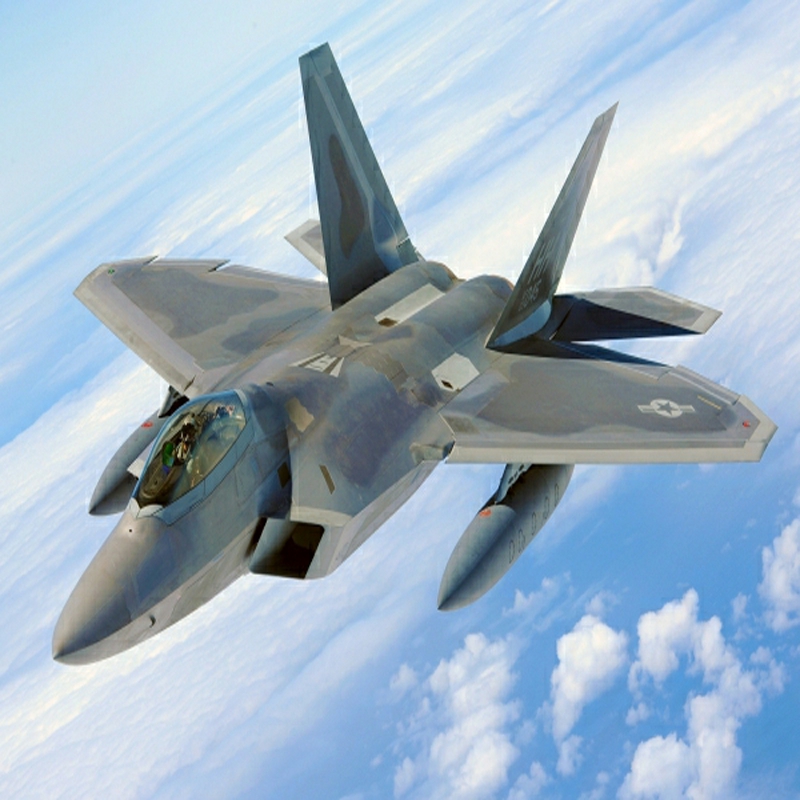
Airframe parts rarely fail because the base material is weak. They fail at the surface: an oxide scale thickens on a turbine blade until the thermal path to the gas stream closes, wind-driven sand erodes a front edge, a reflector pits in salt-laden air until its conductivity drops, or a bolted joint freets and corrodes under the fastener head. Aerospace and defence part coating is therefore selected against the failure mode rather than a single hardness figure.
The engineering envelope is narrow. Substrates range from nickel and titanium alloys to aluminium alloys, stainless steels and carbon-fibre composites, and each carries a thermal budget the process must respect: a composite panel will not tolerate a hot chamber, and solution-treated aluminium loses properties above a few hundred degrees. Film thickness is a design parameter too – hundreds of nanometres for a reflector, micrometres for a hot section.
Typical parts we coat
- Hot-section components: turbine and compressor blades, blade seals, nozzle and shroud rings, heat shields
- Antenna and RF parts: parabolic reflector shells, radome frames, waveguide flanges, strut and feed hardware
- Avionics and electrical parts: connector shells and back shells, slip rings, static discharge brushes
- Airframe structure: brackets, linkage and hinge hardware, fasteners, hydraulic and actuator components
- Composite and light-weight parts: carbon-fibre panels, brackets, antenna supports, equipment mounts
- Optical and surface-finish parts: mirror and window mounts, heat shields, wear strips
Coating options and why they fit
Titanium aluminium nitride (TiAlN)
TiAlN is the working choice for hot metal parts. The aluminium stabilises the cubic structure, so hardness is retained at temperature instead of collapsing as the coating oxidises. Typical room-temperature hardness is about 2800-3300 HV at HV0.05, and HV1000 or better is still present at 700 degrees Celsius. The layer is normally deposited 3-8 micrometres thick at 430-500 degrees Celsius, giving scratch-test critical loads of 50-80 N.
Titanium nitride (TiN)
TiN is the general-purpose film for conductive and wear surfaces, and it carries the gold colour of the arc-deposited variant. A typical film runs 200-800 nm at 2300-2800 HV, with a friction coefficient of 0.12-0.16 against a PTFE counterface. Because it conducts, the same film also serves as an EMI or reflector coating.
Titanium carbonitride (TiCN) and chromium nitride (CrN)
TiCN adds carbon to the nitride lattice. It reaches 2200-2800 HV, holds working properties in air to about 600 degrees Celsius and in inert or vacuum environments to roughly 1200 degrees Celsius, and deposits at 1.5-3 micrometres per hour. CrN is the alternative when thermal stability and chemical inertness matter more than peak hardness: 1800-2200 HV, an elastic modulus near 350 GPa, stability in air to 700 degrees Celsius, and 2000 h of salt spray.
Aluminium nitride (AlN) and diamond-like carbon
AlN is used where heat has to leave the part while electrical isolation is kept: a thermal conductivity of about 320 W/m.K, a melting point of 2200 degrees Celsius, and a thickness uniformity error below plus or minus 5 per cent. DLC (diamond-like carbon) covers rubbing and hermetic surfaces: 7000 HV is reported for the arc-deposited diamond coating, and the ta-C form at up to 85 GPa with a friction coefficient of 0.08.
How the process works
Pre-treatment, ion bombardment, deposition, post-treatment. Parts are ultrasonically cleaned and degreased, then activated: an argon plasma etch at 500 W for 10 minutes has been reported to take an aluminium substrate from Ra 0.2 micrometres to Ra 0.05 micrometres, which the later adhesion depends on. Composite parts receive an oxygen-argon etch instead, and a thin titanium or TiN interlayer of 50-60 nm is deposited first to absorb the difference in thermal expansion.
Ion bombardment inside the chamber strips the last oxide and activates the surface under ion energies of 20-100 eV, so the growing film bonds metallurgically rather than sitting on top of it. Deposition is by arc ion plating, with MF magnetron sputtering where a smoother film is required. Post-treatment removes the loose particles arc sources can produce: a low-temperature anneal at 180 degrees Celsius for 2 h followed by ion-beam polishing at 500 eV gives a surface of Ra 0.03 micrometres or better.
What the numbers look like
- TiAlN, a room-temperature hardness about 2800-3300 HV at HV0.05, HV1000 or better retained at 700 degrees Celsius, and roughly twice the hardness of TiN at 900 degrees Celsius
- TiAlN, oxidation in air typically starting between 750 and 830 degrees Celsius, short-term use up to 900-950 degrees Celsius, a static oxidation gain of 0.5-1.5 mg/cm2 over 100 h at 900 degrees Celsius against 4-10 mg/cm2 for TiN, and a hot-corrosion weight loss 5 to 10 times lower than uncoated in an 850 degrees Celsius salt exposure
- TiN, a typical 200-800 nm film at 2300-2800 HV, a friction coefficient of 0.12-0.16, a sheet resistance of 5-18 ohms per square at 400 nm, and a static dissipation time of 0.03 s or less
- TiN endurance, no pitting over 1200 h in 3.5 per cent sodium chloride neutral salt spray, 99.6 per cent coating integrity after 720 h immersion in aviation hydraulic oil, and no cracking over 1000 thermal cycles between -200 and 120 degrees Celsius
- TiN on aluminium reflectors, 300-800 nm, a sheet resistance down to 0.02 ohms per square at 500 nm, a density of 99.8 per cent or better, and a reflection of 95 per cent or more in the C and Ku bands
- TiCN and CrN, 2200-2800 HV and 1800-2200 HV, stability in air to about 600 and 700 degrees Celsius, a shielding effectiveness of 40-55 dB for TiCN, and 2000 h of salt spray for CrN
- AlN and DLC, a thermal conductivity of about 320 W/m.K, a thickness uniformity error below plus or minus 5 per cent, 7000 HV for the arc-deposited diamond coating and a ta-C hardness up to 85 GPa
- TiN on carbon-fibre composite, 1-3 micrometres at 200 degrees Celsius or lower, a hardness of 2000-3000 HV, a scratch adhesion above 120 N and 1000 h of salt spray without rust
- Composite outgassing, a total mass loss below 1 per cent and collected volatile condensable material below 0.1 per cent under ASTM E595 conditions
Where this fits — and where it doesn’t
- Fits: thin functional films where mass matters and the failure is surface-driven – oxidation, erosion, wear, fretting, salt attack, static charge or EMI behaviour
- Fits: aluminium, titanium, nickel alloys, stainless steels and carbon-fibre composites, where the deposition temperature matches the substrate’s thermal limit
- Does not fit: heavy erosion or deep pitting needing tens or hundreds of micrometres of build-up. Thermal spray or a machined repair stays the right route, and a PVD layer cannot restore lost material
- Does not fit: coated surfaces that later form a press fit, a bolted interface or a sealing face without masking or a dimensional allowance for the added thickness
- Does not fit: composite or polymer panels that cannot tolerate 200 degrees Celsius, and assemblies that need qualification documents or approvals not held here. The figures above are typical process data, and each customer keeps its own qualification route
Frequently asked questions
How thick can the coating be on a hot-section part?
For TiAlN on a turbine or blade component the working range is 3-8 micrometres, deposited at 430-500 degrees Celsius. That is thick enough to act as a thermal and erosion barrier but far thinner than an aluminide or thermal-spray system, so it suits parts where mass dominates. Thicker films are possible, but residual stress and the risk of edge chipping rise while the deposition rate drops.
Can carbon-fibre composite panels be coated without outgassing or matrix damage?
Yes, within limits. The panel is cleaned and etched with an oxygen-argon plasma, a thin titanium or TiN interlayer absorbs the thermal expansion mismatch, and the film is deposited at 200 degrees Celsius or below so the resin matrix does not decompose. Reported outgassing for a coated panel under ASTM E595 is a total mass loss below 1 per cent and collected volatile condensable material below 0.1 per cent.
How is a coating qualified for a reflector or an EMI application?
Three measurements usually decide it. Sheet resistance, checked by four-point probe on the finished part, sets the conductivity: 5-18 ohms per square at 400 nm for a general TiN film, and down to 0.02 ohms per square at 500 nm for the reflector-grade variant. Adhesion is checked by scratch testing, typically 50-80 N critical load for TiAlN and 65-75 N for CrN on superalloy.
Send us a sample for a free coating feasibility assessment. Include the substrate, the service environment, the failure to be stopped and any dimensional limits, and a proposal comes back with the film system, a thickness range and the checks to be run on the parts.
Xi’an Zhiyang Baina Vacuum Coating Co., Ltd. | PVD vacuum coating services and coating technology cooperation for all types of parts. Samples welcome for a free coating assessment.
Address: Xi’an, Shaanxi, China