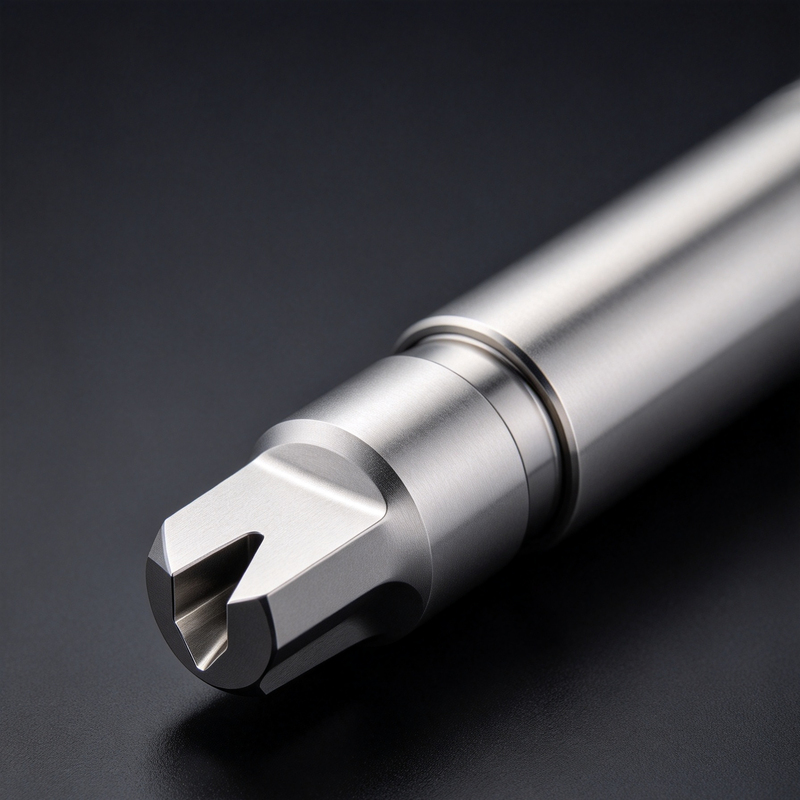
Change forks, throttle shafts, piston rings, injectors and gearbox gears rarely fail as complete components. They fail at the surface: a bright band worn into the working face, pitting in a salt-laden atmosphere, or a light scuff that develops into an intermittent jam. Automotive and marine part coating by PVD puts a hard, low-friction film a few micrometres thick on exactly those surfaces, at a unit cost well below the cost of a replacement.
Four mechanisms usually act together. Adhesive wear appears where the lubricant film breaks down. Abrasive wear comes from dirt, dust and metal chips in the contact. Fretting develops where an interference or splined fit moves slightly under vibration. Electrochemical corrosion is driven by chloride ions in coastal air, road salt and salt-bearing fluids. Selection follows from which of these dominates the duty.
Typical parts we coat
- Driveline: gearbox gears, synchroniser rings, oil pump gears, differential friction faces, shift forks, transmission shafts, splined and interference fits
- Engine and fuel system: piston rings, tappets, cam followers, plungers, needle valves, injector nozzles, throttle shafts
- Turbocharger: turbine wheels, compressor wheels, shafts, journals and floating bearing running surfaces
- Braking and friction pairs: brake friction pair backing plates and their mating friction surfaces
- Marine and hydraulic: low carbon steel hull fittings and deck brackets, hydraulic pump pistons, ship gearboxes and bearings, rudder transmission shafts, crankshafts, ball valve trim
- Fasteners and hardware in salt-laden or sand-contaminated service: screws and nuts, threaded fasteners, pipe and valve bodies, pump housings and sucker rods
Coating options and why they fit
Titanium nitride (TiN)
TiN remains the general option: a hard, chemically stable film with the familiar gold colour, and a moderate cost per part. It is the usual choice for fasteners, because the gold surface makes the part identifiable at assembly and because a copper or steel fastener would otherwise corrode in a damp, salty or acidic environment. Where a coated screw and nut sees salt spray, the quoted result is a film that resists corrosion far longer than the uncoated part.
Chromium nitride (CrN)
CrN is tougher than TiN and chemically more inert, which makes it the better answer where corrosion is the dominant mechanism: coastal atmosphere, road salt, and internal salt-bearing fluids. With a deposition temperature of about 200-300 °C, aluminium parts can still be handled, provided the temperature is kept down and the deformation is checked afterwards. CrN is widely used on valve bodies, pump housings and low carbon steel marine fittings, and on piston rings where sliding wear and corrosion act together.
DLC (diamond-like carbon)
DLC is the low-friction option and the natural answer for sliding parts that run in oil or fuel: piston rings, tappets, plungers, needle valves and injector parts. Coated gears lose less energy in meshing, and under boundary lubrication friction losses fall noticeably, which matters because cold starts, short trips and heavy loads create most of the friction heat. DLC is also chemically inert, which helps in fuel and oil environments.
Titanium carbonitride (TiCN)
TiCN is the harder, lower-friction member of the titanium nitride family and is used where heat and sliding contact are both present. For turbocharger shafts and journals working in sulphuric exhaust and condensation, a TiN base layer with a TiCN outer layer is a recognised combination: the TiN layer supports adhesion and corrosion resistance, the TiCN layer carries the wear.
How the process works
The route is pre-treatment, ion bombardment, deposition and post-treatment. Pre-treatment removes oil, polishing residue and any previous film; on small irregular parts such as forks and fittings this decides whether the coating survives the first service interval. Ion bombardment then strips the last oxide and activates the surface. Deposition by arc ion plating is the usual choice for these shapes, because the plasma wraps well into grooves, threads and recesses; magnetron sputtering where the surface finish has to be smoother. Post-treatment covers cooling, inspection and, on rotating parts, a balance and runout check.
The process window is chosen against the part. A typical base vacuum is below 5×10⁻³ Pa, a working pressure of 0.5-2 Pa, a pulsed substrate bias of -50 to -150 V and a deposition temperature of 200-450 °C are standard here. Coating thickness for automotive hardware is usually 2-6 μm, with 1-5 μm inside a running clearance, and 1-3 μm on gear teeth where the meshing profile must stay within tolerance.
What the numbers look like
- TiN on automotive hardware: typical room-temperature Vickers hardness of 2000-2500 HV (HV0.05), friction coefficient against steel of 0.4-0.6, short-term temperature capability around 500 °C
- CrN: typical Vickers hardness of 1800-2200 HV, deposition temperature about 200-300 °C
- DLC: typical dry friction coefficient of 0.1-0.2, typical Vickers hardness of 1500-3000 HV depending on structure
- TiCN on turbocharger and valve parts: typical Vickers hardness of 2500-3200 HV, friction coefficient typically 0.2-0.4
- Piston ring coated with CrN: bench wear typically 3-5 times lower than an uncoated ring; shift fork contact faces coated with TiN: friction typically 30-50 % lower
- Coated gear mesh: meshing friction loss typically 10-25 % lower; boundary-lubricated friction loss typically 10-30 % lower
- Marine hull fittings and deck brackets with TiN: salt spray resistance typically over 3000 h
- TiN on a fastener: typical Vickers hardness of 2000-3000 HV, salt spray typically 500 h without rust under ASTM B117, thread wear reported 80 % lower
- TiN on a valve body: film thickness typically 300-800 nm, Vickers hardness of 2200-2500 HV at a 50 g load, neutral salt spray typically over 1000 h in 5 % NaCl against 200-300 h for uncoated 304 stainless steel
- Turbocharger protection surfaces in sulphidic exhaust and condensation: service life typically 2-3 times the uncoated part
Where this fits — and where it doesn’t
- Fits: small, low-value parts whose failure is a surface failure — sliding wear, fretting, external corrosion — and where the coating cost per part is a fraction of the line-down cost of that failure.
- Fits: copper and steel fasteners in damp, salty or acidic service, where a thin film is enough to slow the corrosion.
- Does not fit: worn-out components. A part with deep scoring, cracks or a size already out of tolerance should be replaced or re-machined, because the coating reproduces the defect.
- Does not fit: parts whose running-in behaviour matters, such as brake pairs, because a coating changes the initial friction and the contact pattern; validate them on a rig first.
- Does not fit: large flat decorative panels, where the film cost buys nothing, and surfaces that will be masked or painted afterwards.
- Needs checking: lubricant compatibility. Coating and oil additive packages interact, and a friction-reducing film in a fuel or hydraulic system should be validated with the fluid it will run in.
Frequently asked questions
How does PVD coating compare with hard chrome plating?
Hard chrome typically builds tens of micrometres of film, contains hexavalent chromium and adheres mechanically. PVD builds a film of 2-6 μm with a metallurgical bond to the substrate, contains no hexavalent chromium and does not change the part’s geometric accuracy. On a seal face a hard chrome layer normally has to be ground back afterwards; a PVD layer usually does not.
Will the coating change the part’s dimensions?
By the film thickness: typically 2-6 μm, and typically 1-5 μm on clearance parts. Most fits are unaffected, but a piston ring end gap, a plunger clearance or a spline should be checked against the measured value after coating. Parts that need reworking for size should be reworked before coating, never after.
Does the coating affect the lubricant or the fuel?
It can. A DLC or CrN surface behaves differently from bare steel in the first hours of running, and some additive packages are formulated with bare metal in mind. Where a part runs in a specific oil or fuel, supplying that fluid for a compatibility check before the coating is specified is worth it.
Send us a sample for a free coating feasibility assessment. The material, the duty, the operating temperature and the lubrication details are enough to start, and a used part with its failure history tells more than a drawing alone.
Xi’an Zhiyang Baina Vacuum Coating Co., Ltd. | PVD vacuum coating services and coating technology cooperation for all types of parts. Samples welcome for a free coating assessment.
Address: Xi’an, Shaanxi, China